

Engaging with ESG (Environmental Social Governance) topics is unavoidable for companies. Within the framework of mandatory sustainability reporting derived from EU regulations under the CSRD (Corporate Sustainability Reporting Directive) and ESRS (European Sustainability Reporting Standards), the double materiality assessment plays a central role. What does it mean and what should be considered?
Introduction to CSRD
In December 2022, the CSRD, Corporate Sustainability Reporting Directive, was published. The directive leads to a new regulation and significant expansion of mandatory sustainability reporting at the EU level. In order to improve the comparability and quality of sustainability information, dedicated European reporting standards, the ESRS, European Sustainability Reporting Standards, have also been developed. Currently, there are twelve standards, which are divided into two general (ESRS 1 and ESRS 2) and ten topic-specific standards. The latter address topics in the areas of environment (ESRS E1 to ESRS E5), social (ESRS S1 to ESRS S4) and governance (ESRS G1).
Understanding what matters: Double materiality as the core of the ESRS
The general standards, ESRS 1 and ESRS 2, contain general requirements and disclosures regarding reporting and must therefore be observed across industries and topics. ESRS 1 ("General Requirements"), which governs the principle of double materiality, is of particular focus. The double materiality assessment is the core element of mandatory sustainability reporting under ESRS and requires a comprehensive consideration of the business model from different perspectives.
In the process of the double materiality assessment, material topics in the areas of environment, social and governance must be identified for the respective company and assessed in terms of impacts, risks and opportunities.
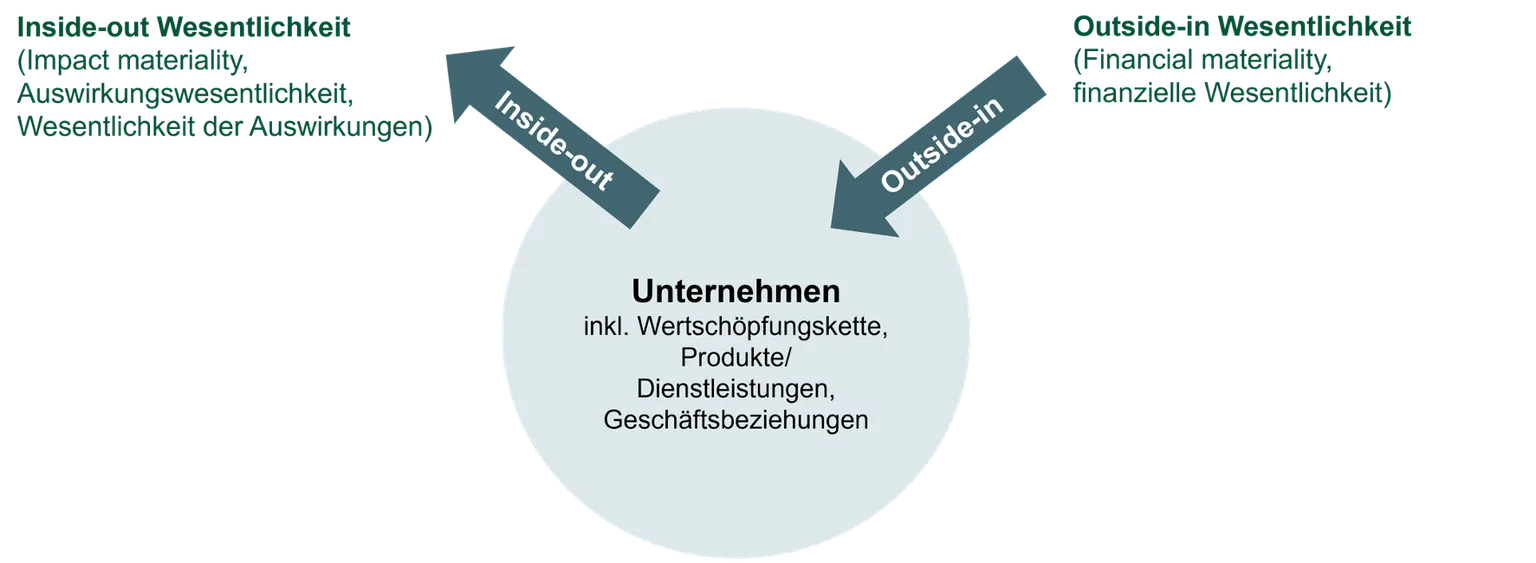
Subsequently, companies must report on the identified topics in accordance with the corresponding topic-specific ESRS. The principle of double materiality requires the consideration of sustainability topics with regard to two dimensions: the so-called inside-out perspective, also known as impact materiality, and the so-called outside-in perspective, also known as financial materiality. Impact materiality takes into account actual or potential, positive or negative impacts of business activities on people and the environment over a short-, medium- or long-term time horizon. Financial materiality, on the other hand, considers the impact of sustainability aspects on the short-, medium- or long-term financial situation of the company and captures the resulting risks and opportunities. Topics are considered material if materiality has been determined with regard to one of the two dimensions (impact materiality or financial materiality).
The sustainability reporting provides for the inclusion of the company's entire value chain. Therefore, in the course of the double materiality assessment, it is necessary to consider both the upstream and downstream value chain as well as all business activities in depth. In addition to examining one's own business practices, this also includes an analysis of business relationships, products and services.
After conducting the double materiality assessment, companies must report on their topics identified as material in accordance with the corresponding ESRS Standards and collect the relevant data.
Overview of the double materiality assessment process
Since the double materiality assessment is a process lasting several months, it is advisable, especially for companies that are subject to reporting requirements from 2025 onwards, to begin implementation in good time. This way, the material topics can be identified early on in order to subsequently collect the relevant data for the reporting financial year and meet the requirements of the CSRD reporting obligation in a timely manner.
We are happy to assist you with any further questions!