

- The way in which communication takes place (communication tools)
The aim of internal communication is the exchange between management and employees, the transfer of knowledge, and the strengthening of motivation for the company itself and specific topics such as sustainability within the company.
What tools are available for internal communication?
As described above, internal communication encompasses the way in which communication takes place. A major focus here is on the communication tools, which represent the channels for transmitting information, updates, the implementation of measures, etc. A distinction can be made between analog and digital communication tools. Since not every employee has online access, each company must individually choose the most useful tools and adapt them to the type of workforce (production, office, etc.) and the size of the workforce.
Analog channels of internal communication include, for example:
- Employee magazine
- Bulletin board
- In-person events / town hall meetings
Digital channels of internal communication include:
- Intranet
- Internal blog
- Wiki (a company's own encyclopedia for information about the company)
- Internal newsletter / emails
- Instant messaging tools (e.g., MS Teams)
- Video conferences
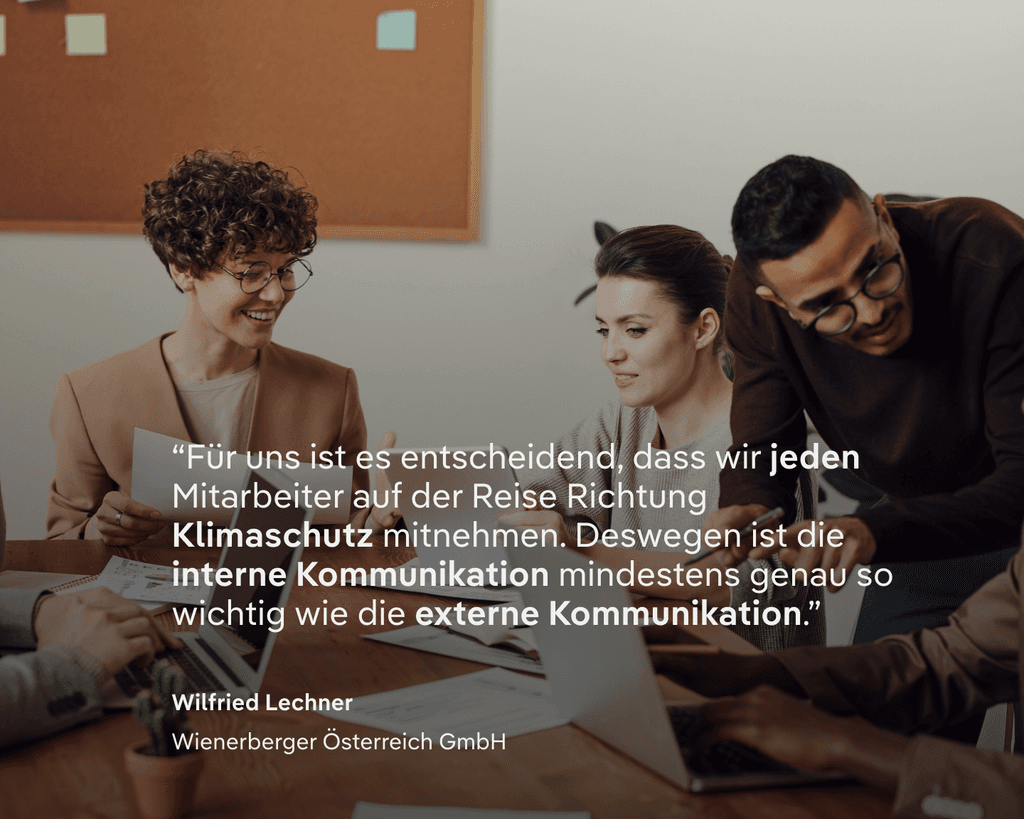
How can all employees be involved in the climate transformation? The brick manufacturer Wienerberger Österreich GmbH has set itself the goal of climate neutrality by 2050 and has been actively making decisions for years that focus on minimizing the company's CO2 emissions. "For us, it is crucial that we take every employee along on the journey toward climate protection. That's why internal communication is at least as important as external communication," says Lechner. As a production company, Wienerberger faces the challenge of informing both office and production employees about measures, decisions, and changes in the area of climate protection within the company, and convincing them of their necessity.
As a communication body, the company implemented a so-called "Green Team," which unites sustainability officers from all departments, age groups, and genders, who act as "sounding boards" to communicate the idea of climate protection within the company. The head of this Green Team is Lechner himself, who, together with a colleague, focuses on the area of biodiversity. In production, the Green Team representative focuses on the area of decarbonization. Since the 380 employees in production do not have online access, communication must take place through alternative channels. Here, the company makes use of so-called "town hall meetings," by definition gatherings at which a representative of management answers employees' questions. Furthermore, the company communicates through employee newspapers and through specific addresses by the executive board. Office employees can be reached via emails and digital media.
Action week to bring climate protection closer to all employees
As part of the Glacier Climate Week, Wienerberger carried out in-house initiatives to bring climate protection closer to employees and actively motivate them to take action. Awareness and knowledge about climate protection were conveyed through on-demand videos, and to achieve a lasting change in behavior, gamification was used in the form of a Climate Challenge. With gamification, elements from entertainment games are placed in a different context, which in a learning context leads to a playful transfer of knowledge.
In summary, this means:
To bring about lasting changes in employee behavior and to successfully embed climate protection into a company's DNA, transparent communication about measures and climate goals is essential. With a Green Team as advocates in the area of sustainability, internal communication on the topic of climate protection is possible both top-down and bottom-up. CO2 savings can be made in every area of a company, which is why not only office employees but, as in this example, also production employees must be involved in the company transformation. Strategies for successful internal communication are key here. Production employees without online access can be reached, among other things, via:
- Town hall meetings
- Direct communication (employee newspapers)
- Specific addresses (executive board)
while office employees can be informed about new measures via emails and digital media.